Moravec's Paradox
Simple explanation
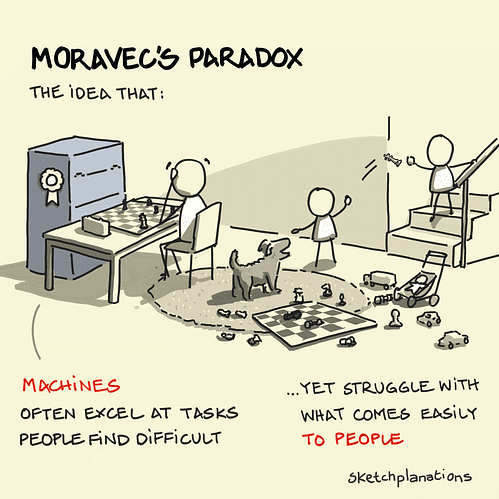
Moravec's Paradox is the observation that the tasks humans find easy are often extremely hard for computers, while the tasks humans find difficult are often relatively easy for computers.
A computer can beat world champions at chess, perform massive calculations, and solve complex equations. Yet getting a robot to walk through a cluttered room, recognize objects reliably, or pick up a cup without mistakes turns out to be incredibly difficult.
The paradox is that our intuition predicts the opposite.
The core idea
The skills humans perform effortlessly—seeing, moving, recognizing faces, understanding physical space—are often the hardest to reproduce in machines.
The skills humans consciously struggle with—formal logic, mathematics, calculation, rule-based games—are often easier for computers because they can be explicitly programmed or optimized.
Key concepts
Evolution did the hard work
Humans have spent hundreds of millions of years evolving perception and movement systems. Those abilities feel effortless because evolution already solved them.
Conscious effort is misleading
We assume difficult-feeling tasks are computationally difficult. Often the reverse is true.
Perception is incredibly complex
Recognizing a face in bad lighting or identifying an object from a strange angle involves enormous amounts of information processing.
Movement is not "just movement"
Walking, balancing, reaching, grasping, and avoiding obstacles require constant real-time adjustments.
Rules are easier than reality
Chess has fixed rules and a limited environment. The real world is messy, noisy, and unpredictable.
Human expertise is often unconscious
You can recognize a friend's face instantly, but you probably cannot explain precisely how you did it.
AI progress often follows the paradox
Many breakthroughs first appeared in areas like calculation, games, and pattern optimization before reaching human-like perception and physical interaction.
One analogy
Imagine you inherit two machines.
One machine was built and refined every day for 500 million years.
The other was assembled over a few decades.
The ancient machine is your brain's perception and movement system. The newer machine is your conscious reasoning system.
Moravec's Paradox says we often mistake the newer machine for the harder one because we're aware of its effort, while the older machine works invisibly.
Where it actually matters
Understanding what AI will automate first
People often assume manual jobs are safe because they seem simple. In reality, physical tasks in messy environments are often harder to automate than office calculations.
Designing software and products
Features that seem trivial to humans—image recognition, speech understanding, object detection—can require enormous engineering effort.
Learning new skills
Just because something feels automatic doesn't mean it's simple. Skilled athletes, musicians, and drivers rely heavily on unconscious systems that took years to develop.
Evaluating AI claims
If someone says an AI can pass a difficult exam, that doesn't automatically mean it can reliably clean a kitchen, stock shelves, or navigate a busy street.
Common confusions
"Moravec's Paradox says AI can never do human perception."
Wrong model: Hard means impossible.
Why it forms: People confuse current difficulty with permanent impossibility.
The paradox is about relative difficulty, not impossibility.
"Chess is harder than walking."
Wrong model: What feels mentally demanding must require more computation.
Why it forms: We directly experience the effort of chess but not the hidden complexity of perception and movement.
"Humans are smarter because we can walk."
Wrong model: Difficulty for computers equals intelligence.
Why it forms: People equate human abilities with general intelligence.
Moravec's Paradox is about computational difficulty, not superiority.
Test your understanding
-
Why might a robot struggle to pick up a toy from a messy floor even if it can solve advanced mathematics?
-
What assumption about "difficulty" does Moravec's Paradox challenge?
-
Why do perception and movement often feel easier to humans than algebra or chess?
Q&A (5 pairs)
Why can a chess-playing AI outperform humans yet struggle with household cleaning? — Real-world perception is harder.
Why does face recognition feel effortless despite complexity? — Processing occurs mostly unconsciously.
If evolution had prioritized algebra, would the paradox differ? — Likely, dramatically so.
Why are fixed-rule environments easier for machines? — Less ambiguity and uncertainty.
Does Moravec's Paradox apply to modern AI models? — Yes, though less strongly.
Accuracy note
Moravec's Paradox is an observation, not a mathematical law. It was formulated by researchers such as Hans Moravec, Marvin Minsky, and Rodney Brooks based on patterns seen in AI and robotics.
The explanation above is simplified. Modern AI has dramatically improved perception tasks such as image recognition and speech recognition, so some examples from the 1980s are less striking today. However, the broader insight remains relevant: robust perception, common sense, and physical interaction with the real world are often much harder than they appear, while formal reasoning tasks can be easier to mechanize than intuition suggests.