Thermocline
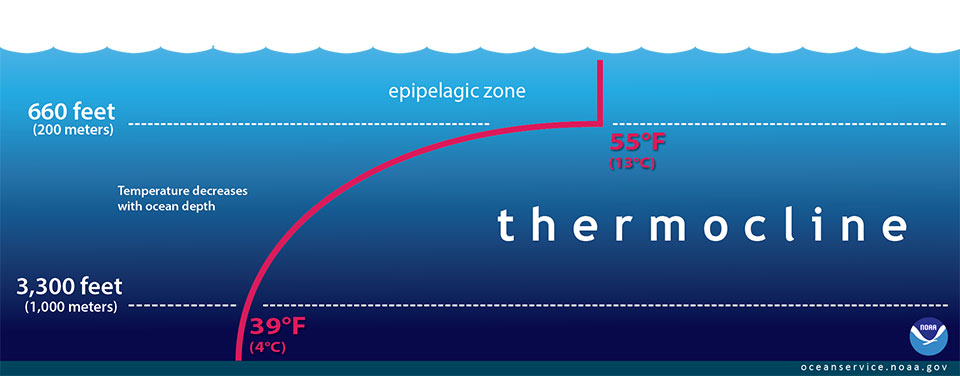
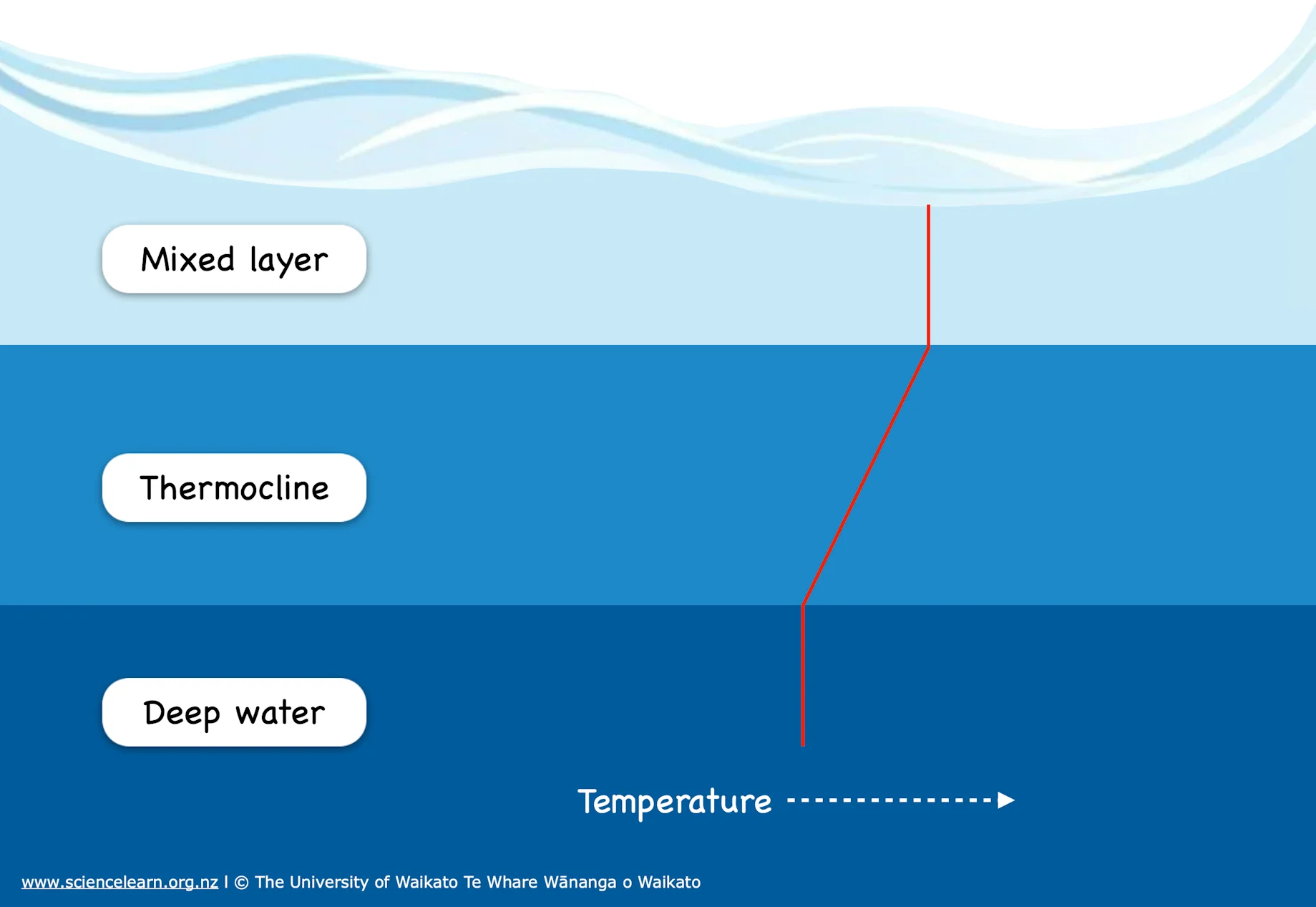
The red line in this illustration shows a typical seawater temperature profile. In the thermocline, temperature decreases rapidly from the mixed upper layer of the ocean (called the epipelagic zone) to much colder deep water in the thermocline (mesopelagic zone). Below 3,300 feet to a depth of about 13,100 feet, water temperature remains constant. At depths below 13,100 feet, the temperature ranges from near freezing to just above the freezing point of water as depth increases.
A thermocline is the transition layer between warmer mixed water at the ocean's surface and cooler deep water below.
Bodies of water are made up of layers, determined by temperature. The top surface layer is called the epipelagic zone, and is sometimes referred to as the "ocean skin" or "sunlight zone." This layer interacts with the wind and waves, which mixes the water and distributes the warmth. At the base of this layer is the thermocline. A thermocline is the transition layer between the warmer mixed water at the surface and the cooler deep water below. It is relatively easy to tell when you have reached the thermocline in a body of water because there is a sudden change in temperature. In the thermocline, the temperature decreases rapidly from the mixed layer temperature to the much colder deep water temperature.
In the ocean, the depth and strength of the thermocline vary from season to season and year to year. It is semi-permanent in the tropics, variable in temperate regions (often deepest during the summer), and shallow to nonexistent in the polar regions, where the water column is cold from the surface to the bottom.
Thermoclines also play a role in meteorological forecasting. For example, hurricane forecasters must consider not just the temperature of the ocean's skin (the sea surface temperature), but also the depth of warm water above the thermocline. Water vapor evaporated from the ocean is a hurricane's primary fuel. The depth of the thermocline is the measure of the size of the "fuel tank" and helps to predict the risk of hurricane formation.
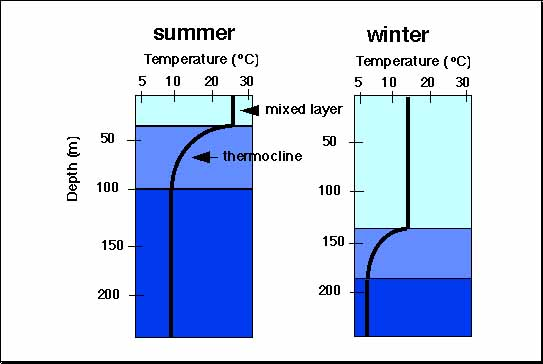
Oceanographers usually graph their data with depth plotted downward on the y-axis , so that the graphed data provide a cross-sectional view of the actual ocean
The oceans have a well-mixed surface layer where the water temperatures are relatively constant. Below the mixed layer is the thermocline, a zone where temperature changes rapidly with depth. Below the thermocline the temperature is relatively uniform with depth, showing only a small decrease to the ocean bottom.
The temperature structure of the upper ocean varies during the year. The density of water varies with temperature and salinity; with cold water denser than warm, and highly saline water denser than less saline. During the summer the surface water warms. As warmer water is less dense than cold, this warm water remains at the surface and the water column is “stable”. There is little wind so the mixed layer is shallow, as is the thermocline. During the fall and winter, cooler temperatures and wind from storms cool the surface waters. This increases the density of the surface water, which then sinks to a level of similar density. This combination of cooling and wind mixing causes a deep mixed layer. In the spring, the water warms again and the thermocline reforms.

A thermocline (sometimes metalimnion in lakes) is a thin but distinct layer in a large body of fluid (e.g. water, such as an ocean or lake, or air, such as an atmosphere) in which temperature changes more rapidly with depth than it does in the layers above or below. In the ocean, the thermocline may be thought of as an invisible blanket which separates the upper mixed layer from the calm deep water below. Depending largely on season, latitude and turbulent mixing by wind, thermoclines may be a semi-permanent feature of the body of water in which they occur or they may form temporarily in response to phenomena such as the radiative heating/cooling of surface water during the day/night. Factors that affect the depth and thickness of a thermocline include seasonal weather variations, latitude and local environmental conditions, such as tides and currents.
Thermoclines can also be observed in lakes. In colder climates, this leads to a phenomenon called stratification. During the summer, warm water, which is less dense, will sit on top of colder, denser, deeper water with a thermocline separating them. The warm layer is called the epilimnion and the cold layer is called the hypolimnion. Because the warm water is exposed to the sun during the day, a stable system exists and very little mixing of warm water and cold water occurs, particularly in calm weather.
One result of this stability is that as the summer wears on, there is less and less oxygen below the thermocline as the water below the thermocline never circulates to the surface and organisms in the water deplete the available oxygen. As winter approaches, the temperature of the surface water will drop as nighttime cooling dominates heat transfer. A point is reached where the density of the cooling surface water becomes greater than the density of the deep water and overturning begins as the dense surface water moves down under the influence of gravity. This process is aided by wind or any other process (currents for example) that agitates the water. This effect also occurs in Arctic and Antarctic waters, bringing water to the surface which, although low in oxygen, is higher in nutrients than the original surface water. This enriching of surface nutrients may produce blooms of phytoplankton, making these areas productive.
As the temperature continues to drop, the water on the surface may get cold enough to freeze and the lake/ocean begins to ice over. A new thermocline develops where the densest water (4 °C) sinks to the bottom, and the less dense water (water that is approaching the freezing point) rises to the top. Once this new stratification establishes itself, it lasts until the water warms enough for the ‘spring turnover,’ which occurs after the ice melts and the surface water temperature rises to 4 °C. During this transition, a thermal bar may develop.
Waves can occur on the thermocline, causing the depth of the thermocline as measured at a single location to oscillate (usually as a form of seiche). Alternately, the waves may be induced by flow over a raised bottom, producing a thermocline wave which does not change with time, but varies in depth as one moves into or against the flow.
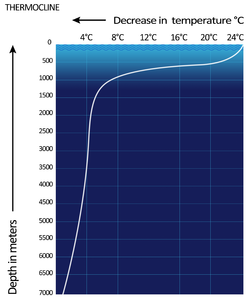
Graph showing a tropical ocean thermocline (depth vs. temperature). Note the rapid change between 100 and 1000 meters. The temperature is nearly constant after 1500 meters depth.
Most of the heat energy of sunlight is absorbed in the first few centimeters at the ocean’s surface, which heats during the day and cools at night as heat energy is lost to space by radiation. Waves mix the water near the surface layer and distribute heat to deeper water such that the temperature may be relatively uniform in the upper 100 m (300 ft), depending on wave strength and the existence of surface turbulence caused by currents. Below this mixed layer, the temperature remains relatively stable over day/night cycles. The temperature of the deep ocean drops gradually with depth. As saline water does not freeze until it reaches −2.3 °C (colder as depth and pressure increase) the temperature well below the surface is usually not far from zero degrees. [1]
The thermocline varies in depth. It is semi-permanent in the tropics, variable in temperate regions (often deepest during the summer) and shallow to nonexistent in the polar regions, where the water column is cold from the surface to the bottom. A layer of sea ice will act as an insulation blanket.
In the open ocean, the thermocline is characterized by a negative sound speed gradient, making the thermocline important in submarine warfare because it can reflect active sonar and other acoustic signals. Technically, this effect stems from a discontinuity in the acoustic impedance of water created by the sudden change in density.
When scuba diving, a thermocline where water drops in temperature by a few degrees Celsius quite suddenly can sometimes be observed between two bodies of water, for example where colder upwelling water runs into a surface layer of warmer water. It gives the water an appearance of wrinkled glass that is often used to obscure bathroom windows and is caused by the altered refractive index of the cold or warm water column. These same schlieren can be observed when hot air rises off the tarmac at airports or desert roads and is the cause of mirages.
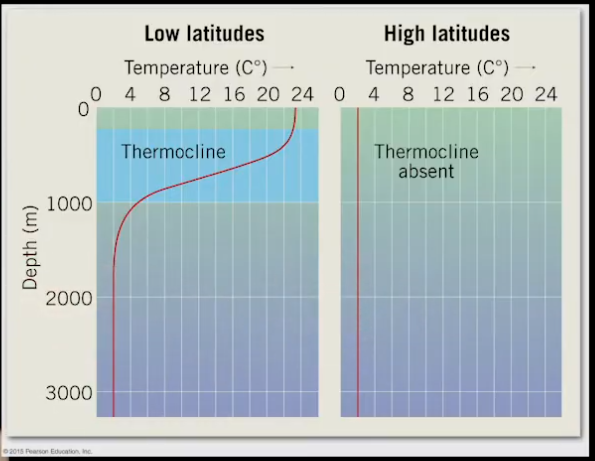
A thermocline is absent in high latitudes because the ocean there does not maintain a stable temperature contrast between surface and depth.
At low and mid-latitudes, strong solar heating warms the surface while deeper water remains cold. This creates a sharp vertical temperature gradient, which is the thermocline. In high latitudes, this contrast does not develop.
Solar input is weak and highly seasonal, so surface waters never become much warmer than deeper layers. At the same time, persistent winds and frequent storms drive continuous vertical mixing. This mixing distributes heat throughout the water column, preventing the formation of a stable layered structure.
Additionally, cooling at the surface increases water density. When surface water becomes colder (and often saltier due to processes like sea ice formation), it sinks and mixes with deeper water. This process, a form of Convection, further eliminates any developing temperature gradient.
As a result, the water column in high latitudes is typically close to isothermal, meaning temperature is nearly uniform with depth. Without a strong and persistent temperature difference, a thermocline cannot form or is only weak and temporary.
Water expands when it warms up – heat energy makes its molecules move around more and take up more space. Because the molecules are more spread out, the density goes down. When water cools, it contracts and becomes denser.
Temperature and salinity both affect the density of water, resulting in water moving up or down through the ocean layers and moving as currents around the ocean
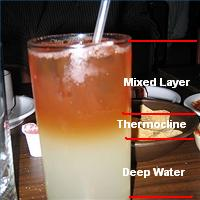
A good example is a popular beverage where ice cold lemonade (deep water layer) is poured into a glass with warm ice tea (mixed layer) poured slowly on top of the lemonade. The result is a separation of the fluid because of the difference in temperature. As you can see, the warm ice tea remains at the top of the glass while the ice cold lemonade remains at the bottom. The thermocline is the layer where the two fluids intermingle.
Once you stir the glass (simulates wind creating wave action) with a straw, the two fluids will mix and cause the thermocline to disappear or fluctuate in depth.
The lower atmosphere also typically contains a boundary between two distinct regions (the troposphere and stratosphere), but that boundary (the tropopause) displays quite different behavior. However, atmospheric thermoclines, or inversions, can occur, e.g. as nighttime cooling of the Earth’s surface produces cold, dense, often calm air adjacent to the ground. The coldest air is next to the ground, with air temperature increasing with height. At the top of this nighttime boundary layer (which may be only a hundred meters) the normal adiabatic temperature profile of the troposphere (i.e. temperature decreasing with altitude) is again observed. The thermocline or inversion layer occurs where the temperature profile changes from positive to negative with increasing height. The stability of the night time inversion is usually destroyed soon after sunrise as the sun’s energy warms the ground, which warms the air in the inversion layer. The warmer, less dense air then rises, destroying the stability that characterizes the nightly inversion.
This phenomenon was first applied to the field of noise pollution study in the 1960s, contributing to the design of urban highways and noise barriers.
The “phenomenon” being referred to is the same underlying physics that produces a thermocline: a gradient in a fluid that changes how waves travel. In the ocean, a thermocline is a sharp vertical change in temperature (and therefore density), which bends sound waves as they move through water. In the atmosphere, temperature gradients do the same thing to sound in air.
In both cases, the key idea is refraction. The speed of sound depends on the properties of the medium—temperature, density, and pressure. When those properties change with height or depth, sound waves no longer travel in straight lines; they curve toward regions where their speed is lower. This is governed by the same principle as Refraction.
In the ocean:
- A thermocline creates a layered structure where sound speed changes with depth.
- Sound waves bend and can become trapped or guided along certain layers.
- This is why thermoclines matter for sonar and underwater acoustics.
In the atmosphere:
- Temperature gradients (especially near the ground) create similar sound-speed variations.
- For example, cooler air near the surface and warmer air above (a temperature inversion) can bend sound back toward the ground.
- This can make distant traffic noise seem louder at night or over long distances.
The work in the 1960s on noise pollution applied this atmospheric version of the same principle. Engineers realized that temperature gradients affect how sound from highways propagates. That insight influenced:
- placement and height of noise barriers,
- prediction of how far sound would travel,
- and urban road design.
So the connection is not that thermoclines themselves were used in cities, but that the same physics—wave behavior in layered media with temperature-dependent properties—applies in both ocean thermoclines and atmospheric acoustics.
Thermocline shock refers to the sudden sensory and physiological response experienced when a diver passes through a thermocline, where water temperature decreases rapidly over a short vertical distance. The abrupt change in temperature exposes the skin to a sharp thermal gradient, producing an immediate cold sensation that is often perceived as intense relative to the actual temperature difference because of the high thermal conductivity of water. This rapid cooling stimulates cutaneous thermoreceptors, triggering reflex responses such as an involuntary gasp or brief hyperventilation, particularly in unacclimatized individuals. The effect is not due to pressure or mechanical forces but arises from the body’s acute sensitivity to rapid heat loss and temperature change. Although generally not harmful, the suddenness of the response can momentarily disrupt breathing control and awareness, which is why it is emphasized in diving practice and training.
Thermocline shock is the immediate physical reaction a diver feels when crossing a thermocline, where the water temperature drops suddenly over a very small depth. As the diver moves from warmer to colder water, heat is lost rapidly from the body because water conducts heat much more efficiently than air. This sudden cooling strongly stimulates the skin’s temperature sensors, leading to an intense cold sensation that feels sharper than the actual temperature change. In some cases, the body responds reflexively with a brief gasp or change in breathing, especially if the diver is not expecting it. The effect is not dangerous by itself, but the abruptness of the sensation can be surprising and momentarily distracting, which is why divers are trained to anticipate it and maintain controlled breathing when passing through such layers.